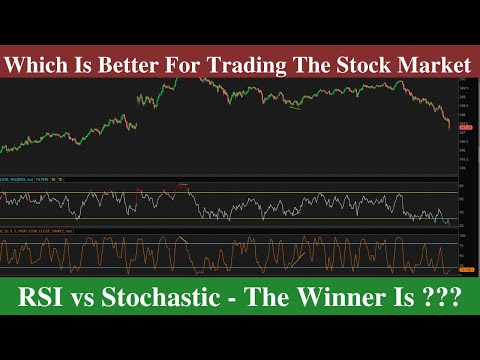
Stochastic Oscillator vs RSI: Stop Worshipping Signals, Start Reading Crowd Psychology
Dec 2, 2025
Traders argue for years over Stochastic Oscillator vs RSI, as if one magic setting will finally tame the market. That fight misses the point. These tools are not rivals. They are lenses on crowd emotion. If you treat them as simple overbought and oversold gadgets, you get the scraps. If you treat them as psychological instruments, you start to see where fear, exhaustion, and greed actually turn.
You are not choosing an indicator. You are choosing which layer of mass psychology you want to see.
What They Really Measure: Under The Hood Of Crowd Emotion
Forget the formulas for a moment. Think in terms of human behaviour.
Stochastic Oscillator asks:
Where is the current close inside the recent range, and what does that say about urgency?
In an uptrend, strong buyers tend to push prices close to the top of the range. In a downtrend, aggressive sellers press close toward the bottom. Stochastic is a closing-pressure gauge. It tracks how desperately participants want to own or dump something in the short term.
Readings above 80 do not just mean “overbought.” They tell buyers are crowding into the top of the recent range with maximum enthusiasm. Readings below 20 do not just mean “oversold.” They show sellers driving prices into the basement, often near emotional capitulation.
RSI asks a different question:
How strong is the recent imbalance between buying and selling, and is that strength fading?
It compares average gains to average losses. That ratio is not merely math. It is a conviction translated into a scale from 0 to 100. Strong trends push RSI into extended zones and keep it there. Turning points often appear when RSI starts to diverge from price, even while the chart still looks “fine.”
Price making new highs while RSI makes lower highs is not a cute pattern. It is a shrinking belief. Buyers push price, but the emotional fuel behind the move leaks away. Price making new lows while RSI stops making new lows is the same story in reverse. Sellers are tired before the chart admits it.
Stochastic focuses on where we close inside the range, RSI on how hard the crowd is still pushing. One maps position—the other maps force.

Stochastic Oscillator vs RSI: Where Each One Dominates
They shine in different regimes. The edge comes from knowing which regime you are in.
When Stochastic Is Your Primary Weapon
Stochastic excels in range-bound markets, where price vibrates between support and resistance and mean reversion rules. Psychologically, these are periods of uncertainty. Bulls and bears are roughly balanced. No story is strong enough to dominate.
In that environment:
- Price grinds into resistance, Stochastic pushes above 80, and closes hugging the top of the range. Buyers are emotionally stretched.
- Price slides into support, Stochastic sinks below 20, closes hug the bottom. Sellers are emotionally stretched.
You are not betting on magic levels. You are betting that human beings cannot keep pushing in one direction inside a box forever. Stochastic gives you the timing on when that stretch is reaching its limit.
When RSI Should Take Over
RSI shines in trending markets, where a dominant narrative takes over and price marches in one direction for weeks or months.
In those conditions:
- Strong uptrends keep RSI elevated and often hold pullbacks above the 40–50 zone.
- Strong downtrends keep RSI depressed and often cap rallies below the 50–60 zone.
Here, mean reversion is a trap. The crowd is committed. You want to know when that commitment is weakening. That is RSI’s home turf.
RSI gives you two key psychological signals in trends:
- Is the trend still strong enough to ride, despite noise?
- Are we seeing early signs of belief fading, even if price has not cracked yet?
Use Stochastic to surf the edges of ranges. Use RSI to judge the health of trends.
The Power Move: When They Agree For Different Reasons
The real money is not in using Stochastic or RSI. It is in watching when they converge.
You get high conviction when:
- Stochastic flags an extreme inside the range
- RSI confirms momentum exhaustion or divergence
Examples of a high-grade short setup:
- Price pushes to a new high.
- Stochastic is above 80, showing closing strength at the very top of the range.
- RSI fails to make a new high or even rolls over.
Translation:
Short-term traders are still jamming prices into the highs, but the underlying belief is weakening. Last buyers are entering while conviction leaks out. That is how tops form.
For longs, flip the picture:
- Price makes a marginal new low.
- Stochastic is below 20, closes are being dumped near the range low.
- RSI holds a higher low, signalling selling force is fading.
Translation:
Sellers are throwing their last punches. Pressure is still visible in price, but the emotional power behind the move is gone. That is typical bottom soil.
When Stochastic and RSI both point to the same turn, using different logic, you are no longer guessing. You are watching two separate psychological thermometers hit the same reading.
Divergence: The Early Warning Siren
Divergences are where these tools stop being “indicators” and start being X-rays.
Bearish divergence:
Price: higher highs
Indicator: lower highs
This is not just “weakness.” It is the crowd running out of emotional fuel while price continues out of habit. Buyers pay higher prices with less enthusiasm. That is how cliffs appear.
Bullish divergence:
Price: lower lows
Indicator: higher lows
Selling pressure continues on the chart, but the intensity behind it is fading. Sellers are exhausted. Forced selling dries up. Strong hands begin to buy while headlines still scream doom.
Read divergence as a timing gap between psychology and price:
- Psychology turns first in the indicator.
- Price follows when enough traders finally act on that drain or rebuild of conviction.
Use divergence from either Stochastic or RSI as an early signal. Use their joint divergence as a serious alert.
Building A Simple, Brutal Framework
Strip this down to a framework you can actually trade.
Step 1: Classify the environment
Ask two questions:
- Are we trending or ranging?
- Price hugging one side of a major moving average with directional bias: trending.
- Price oscillating around it without real follow-through: ranging.
- Is volatility expanding or contracting?
- Big bars and spikes: emotional, more reactive.
- Tight bars and controlled ranges: more measured, less panic.
Step 2: Decide who leads
- Ranging, calmer volatility:
Stochastic leads. RSI confirms. - Trending, calmer:
RSI leads. Stochastic refines entries. - Wild, spiky conditions:
Stochastic for extremes, RSI for “is this just panic or true trend change.”
Step 3: Demand confirmation
Avoid single-indicator hero trades. Instead:
- For reversals, want at least:
- Extreme Stochastic or RSI level
- Plus some kind of divergence, failure, or key level reaction
- For trend trades, want:
- RSI holding supportive zones in the direction of the trend
- Stochastic cycling and resetting without blowing out against the trend
You are not hunting perfect tops and bottoms. You are hunting psychological asymmetry, where the crowd’s emotional position is fragile, and your risk is clearly defined.
From Indicator Addiction To Psychological Reading
Most traders stay stuck at the surface:
- “Stochastic above 80, I sell.”
- “RSI above 70, I sell.”
They confuse a reading with a command. That is why they keep selling into strong trends and buying every early dip during real crashes.
Your shift is simple:
- Treat Stochastic as a map of where the close sits inside the recent emotional battlefield.
- Treat RSI as a measure of how intense that battle still is.
- Treat the agreement between them as a serious confirmation, not a coincidence.
- Treat context as the first filter: trend vs range, calm vs chaos.
Stochastic Oscillator vs RSI is the wrong fight. The real battle is whether you will use them like a robot, or like a trader who understands that every tick is human emotion translated into price.
You do not need more indicators. You need deeper eyes.